 To graduate high school as required I took government as I’m sure everyone did. Although I’d have denied it then, it was one of my favorite classes. I took pride in learning about how our government worked, especially the system of checks and balances set up between the three branches of government. If one branch went astray another branch could set it straight via vetoes, supreme court cases, impeachments, etc. As a citizen, I learned I have the power through my vote to determine who represents me at the federal, state, and local levels. As a democracy the majority rules through our elected representatives. If we are unhappy, we simply vote them out. Right?
In Ohio, the state government models the federal government with three branches of government and the same checks and balances. However, Ohio has one additional check: the ability for citizens to vote directly on proposed amendments to our state constitution. Either the legislature can propose an amendment, or the citizens can initiate the amendment. In either case, currently the majority rules and if 50% +1 of the voters vote for the amendment, it passes.
On paper this all seems logical and fool-proof and so for most of my life I didn’t pay all that much attention to politics and the workings of the government as may be the case for many people. In the past few years watching my social media feeds become more divisive and reading various news outlets, I started paying more attention. But I wanted to know the truth without a media slant one way or the other – difficult to do though. So, for information on what is going on in Ohio’s government, I go straight to www.ohio.gov. (See specific links at the end.) What I’ve learned is that what’s on paper isn’t fool-proof and those checks and balances can fail us.
In 2015 the people of Ohio overwhelmingly approved (71.47%) an amendment that created a bipartisan commission to draw legislative districts that are compact and do not favor one political party or another. The amendment took effect in 2021 when the next redistricting occurred. This amendment determines how both the maps for the Ohio Senate/House Districts and the US House Districts are drawn. The Ohio Supreme Court declared the maps for the Ohio Senate/House Districts to be unconstitutional four times and the commission failed to redraw maps in compliance with the new amendment. (As an aside the governor is on the commission to redraw the maps and his son is on the Ohio Supreme Court. He did not recuse himself from the case.) Pushed against the election deadline in November, the unconstitutional maps went into effect giving the Republican party a super-majority. Additionally, supreme court judges used to be considered non-partisan and a party designation was not included on the ballot. On the November 2022 ballot for the first time, political party designations were included next to judicial candidates.
Where am I going with this? This super-majority has placed an issue on the ballot in a special August election that would strip away this final check to the system. After passing a law in March eliminating August special elections due to the expense and low voter turnout, they reversed course and are holding an election for this one issue on August 8. They are asking voters to raise the threshold to pass any amendment to 60% of the vote instead of 50% + 1. In addition, for citizen-initiated amendments they are asking to require signatures of 5% of the electors in each of Ohio’s 88 counties, rather than in 44 counties in addition to requiring signatures from 10% of the electors that have voted for governor in the previous gubernatorial election. Finally, they want to remove the 10-day period for petitioners to gather additional signatures if they filed an insufficient number of signatures. (A signature becomes invalid, for example, if someone signed it when they lived in one county and then later moved to another county.)
The justification for this higher standard is to prevent special interests from interfering with Ohio’s constitution. In fact, the argument is that this amendment would “save our constitution” from special interests. I argue that the exact opposite is true. The additional requirements would encourage even more special interest money into the state in order to meet the more stringent signature requirements.
Citizen-initiated amendments are already exceedingly difficult to pass. According to the Ohio Attorney General’s Office, since 2006 out of the 94 citizen-initiated petitions for constitutional amendments filed, 53 were certified and only 7 made it to the ballot. In the last 50 years, only 11 out of 40 citizen-initiated constitutional amendments passed. As these numbers indicate, approximately 7% of petitions made it to the ballot and only 27.5% passed. The facts don’t show that our constitution needs to be saved nor do they warrant a special election.
For those who see Issue 1 as a means to stopping the proposed Reproductive Rights Amendment, this amendment will NOT prevent it from appearing on the November ballot. The new signature requirements would NOT go into effect until January 2024. If the petitioners get the required signatures and the amendment does appear on the ballot, as indicated above historically it only has a 27.5% chance of passing. However, 82% of the citizen-initiated amendments that passed, already passed by over 60% of the vote. Are you willing to relinquish your power as an Ohio citizen to initiate all future amendments, for one that isn’t even officially on the ballot yet? Remember this change would also make any amendments that do pass equally as hard to repeal.
If this new 60% threshold were in place at the time these amendments were on the ballot, they would NOT have passed:
- Delete “white” re: males eligible or required to serve in state militia.
- Delete “white male” from voter qualifications.
- Restrict special interest amendments to the Ohio Constitution
- Increase the minimum wage.
Ask yourself why was this proposed amendment rushed to the ballot? Why was the opposition’s testimony cut off after 6? (Note: there were 180 opponent testimonies submitted and only 15 proponents.) Why is this issue being voted on in a special election that has low turnout? Why do four former governors and five former attorneys general (from both parties) oppose it? Who is this really benefiting? It is not the people of Ohio.
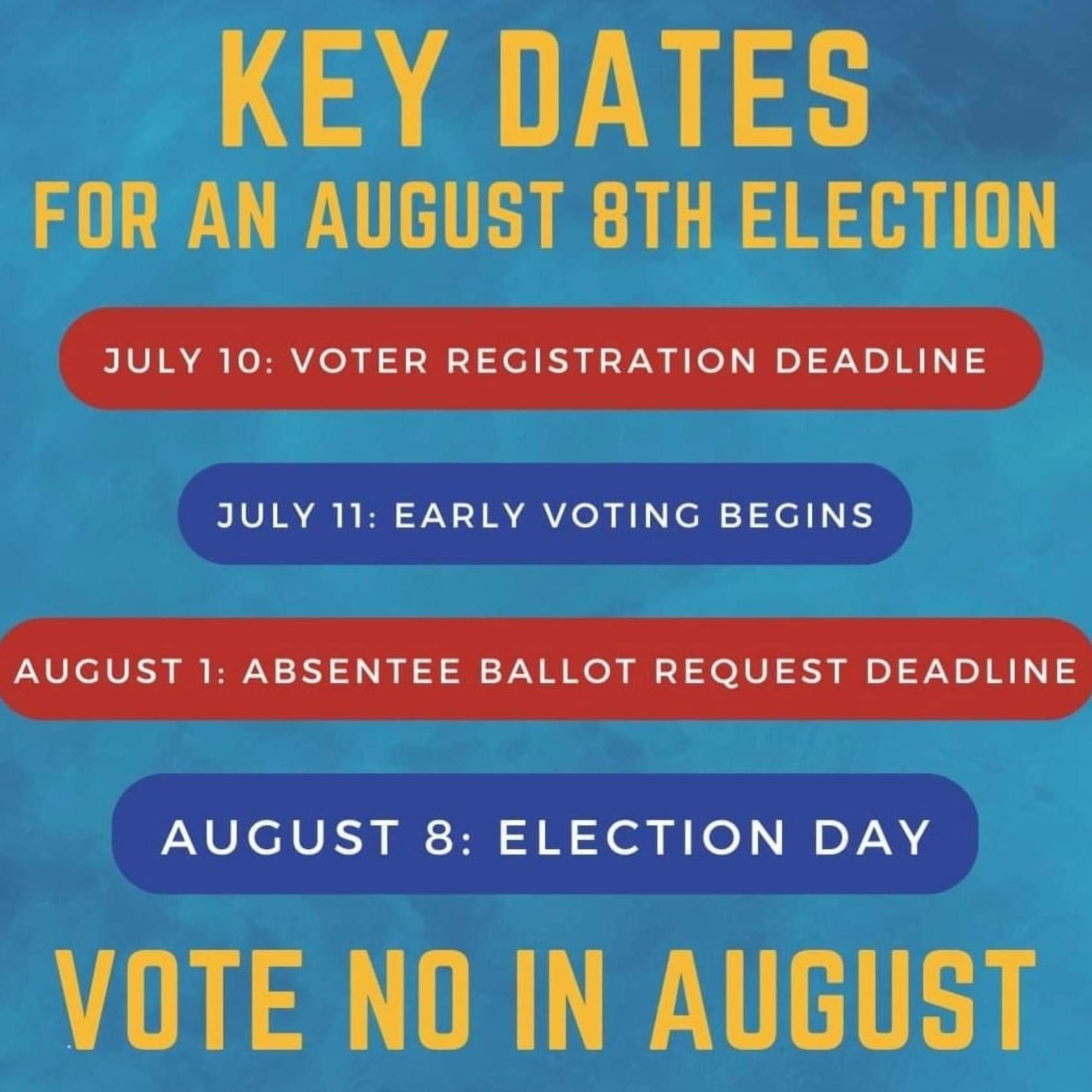
Vote “No” on Issue 1. Register to vote by July 10. Early voting starts July 11 and election day is August 8.
Sources:
- https://www.ohiosos.gov/legislation-and-ballot-issues/putting-an-issue-on-the-ballot/citizen-initiated-constitutional-amendment/
- https://www.ohioattorneygeneral.gov/Legal/Ballot-Initiatives/Petitions-Submitted-to-the-Attorney-General-s-Offi
- https://www.ohiosos.gov/elections/election-results-and-data/historical-election-comparisons/statewide-issue-history/
- https://guides.law.csuohio.edu/c.php?g=190570&p=3200756
- https://guides.law.csuohio.edu/c.php?g=190570&p=9367492
- https://www.legislature.ohio.gov/
- https://ohiohouse.gov/committees/constitutional-resolutions/meetings/cmte_h_constitutional_resolutions_1_2023-04-18-0900_355
- https://ohiohouse.gov/committees/constitutional-resolutions/meetings/cmte_h_constitutional_resolutions_1_2023-04-19-0900_356
- https://ohiocapitaljournal.com/2023/04/25/bipartisan-former-ohio-governors-against-raising-constitutional-threshold-to-60-and-august-vote/
- https://www.statenews.org/2023-05-01/former-ohio-attorneys-general-oppose-resolution-to-make-it-harder-to-pass-constitutional-amendments
- https://www.redistricting.ohio.gov/public-comment
- https://www.statenews.org/government-politics/2022-05-27/federal-court-intervenes-in-ohio-redistricting-orders-state-to-implement-unconstitutional-district-maps


 Undaunted